In the industry you will see it under different names: Promo Package, Media Pack, Artist Package or Electronic Press Kit (EPK). They all mean the same thing: the set of documents and audiovisual material you present when you apply. It works as your introduction and lets a recruiter quickly see who you are, what experience you have and what you can offer.
What it includes
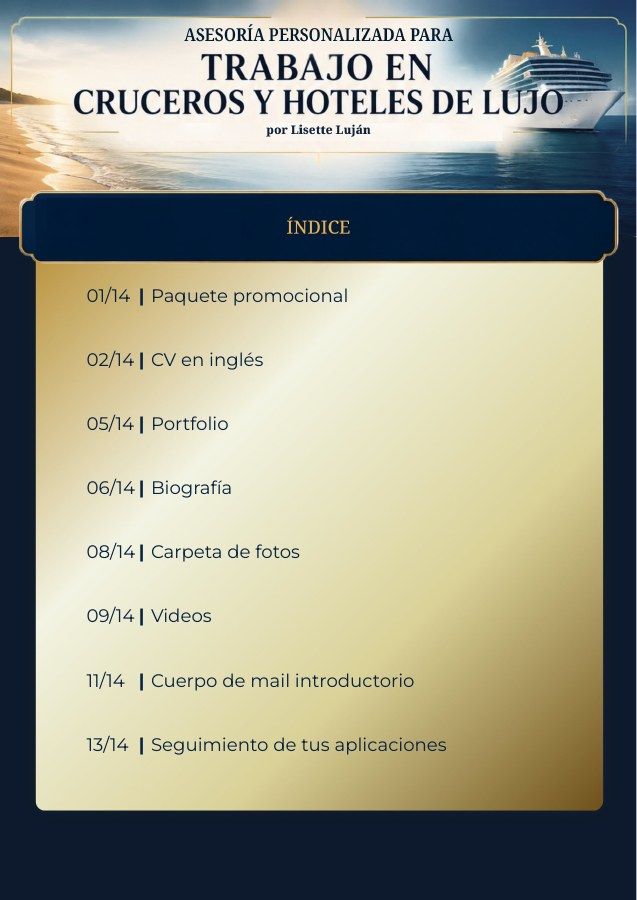
The content depends on your profession, but a promo package usually has:
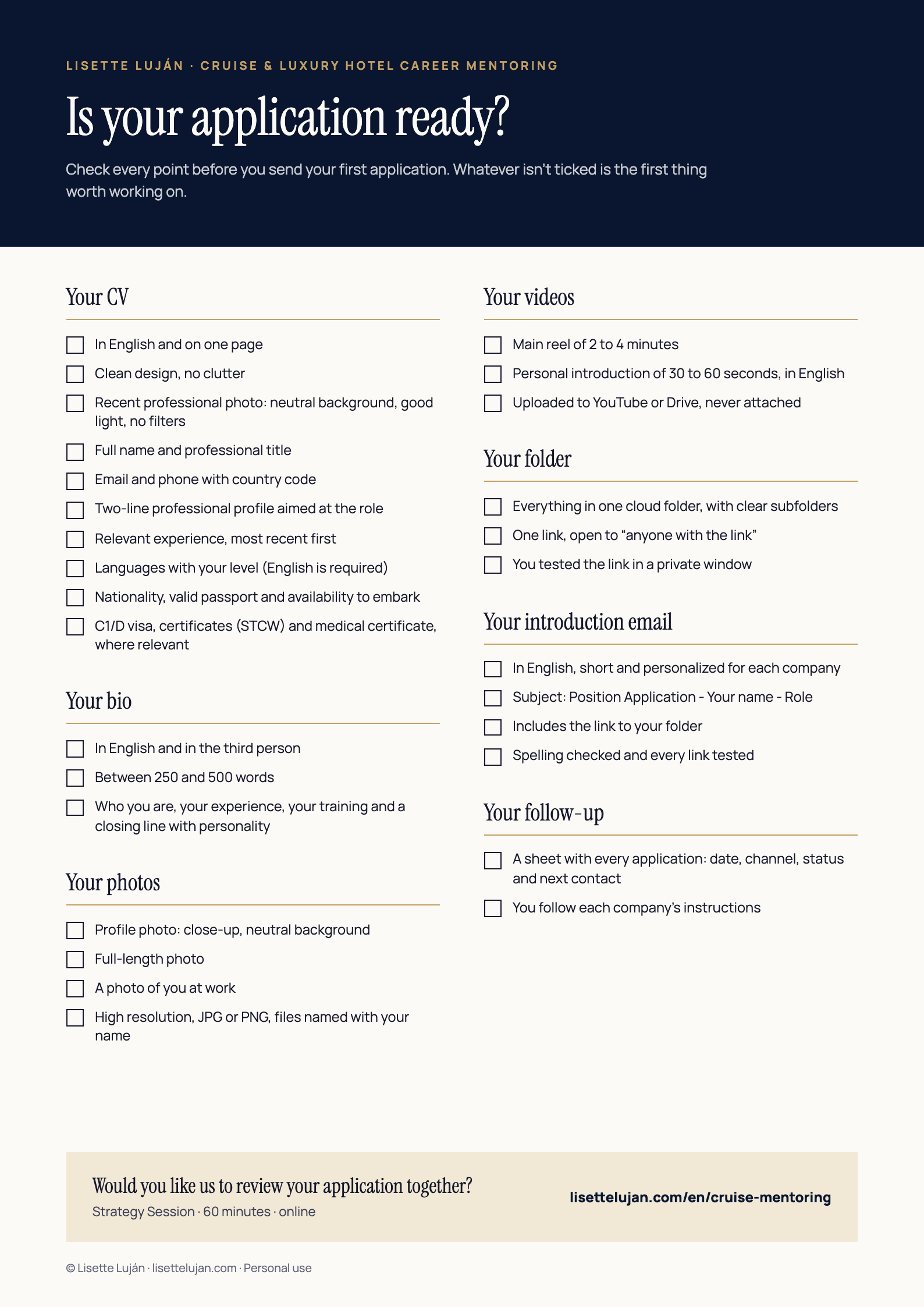
- Your CV in English (I explain how to build it in the CV guide).
- A professional bio.
- A portfolio, if your work can be shown (musicians, photographers, make-up artists, nail artists, baristas, chefs and many more).
- Professional photos.
- Videos.
- Your certificates and, if you are a musician, your repertoire.
How to organize it
There is no single format. What matters most is that everything is organized, up to date and easy to share. Today the most common option is a cloud folder (Google Drive, Dropbox or OneDrive) that you share with a single link.
Inside that folder, create clearly named subfolders: CV, Bio, Photos, Promo Reel, Videos, Repertoire and Certificates. That way the recruiter finds what they need without having to ask you for anything.
Before you send the link, open it from another account or a private window and check that “anyone with the link” can view it.
Your bio
It is a short introduction, more narrative than your CV. Write it in English, in the third person (“She is a…”, “He brings…”), as if someone else were introducing you, in about 250 to 500 words. A structure that works:
- Who you are: name, profession, years of experience and what sets you apart, in two or three sentences.
- Your most relevant experience in cruises, hotels or luxury service, with company names and roles.
- Your education, languages, certifications and the skills recruiters value: adaptability, teamwork, customer service.
- A closing line with personality: one sentence that makes the recruiter want to meet you.
Your photos
They are often the first thing a recruiter sees. You don’t need many: a few good photos that show different sides of your work are better.
- A profile photo: close-up, neutral background, framed from the shoulders, natural smile. This one goes on your CV and bio.
- A full-length photo, in a neutral pose and neat clothes.
- A photo of you at work, in your current or previous job.
- If you have photos on board, in uniform or in luxury settings, add them: they show experience.
Use recent, high-resolution images in JPG or PNG, and name the files with your name.
Your videos
For performers they are required. For hospitality roles, a personal introduction video adds a lot.
- A main reel of 2 to 4 minutes showing your best. Musicians: playing live. Hospitality: introducing yourself in English.
- Short clips of you at work: authenticity matters more than perfect production.
- A personal introduction of 30 to 60 seconds, speaking to camera in English: who you are, where you have worked and why you want to work on cruise ships.
Never attach videos to an email: they are too heavy. Upload them to YouTube (as “unlisted” if you prefer privacy) or Google Drive and share the link.
The introduction email
It is usually your first contact with a recruiter. In English, short and personalized for each company. A simple structure: introduce yourself, summarize your most relevant experience, state your availability and certifications, share the link to your promo package and close by thanking them. For the subject line, keep it clear: “Position Application - Your name - Role”.
Consistency and professionalism in your presentation say as much as your experience.